Start Doing the Work
One of the questions that I get a lot about my consulting and advising work is "how do you get clients?"
My somewhat tongue-in-cheek (but also serious) answer is that you just start doing the work. In a lot of ways, finding a good client (or advisor) is very much like dating, especially because close contact consulting and advising is a relationship business. You are being hired to care about someone's company, team, and customers.
Ideally, you should only agree to a long term relationship if you have some experience with a short term one. Yet, I see so many people trying to close clients in the first meeting.
In my experience, you'll be more successful and happier (in the short and long term) if you start doing the work first and define the relationship later. This is because the best relationships don't change when you label them, especially if you're showing up authentically.
Two Point Five Meetings
When I started working for myself, one of the things I felt most uncomfortable with was closing clients. I enjoyed the conversations and loved diving into their problems. But I didn't know how to talk about formalizing the relationship, especially because I didn't want to sku-ify myself.
I asked a number of smarter people in my network how they approached this and the best advice came from Casey Winters, who said that he doesn't try to close a client until 2.5 meetings in (i.e. in the third meeting). Doing this gave him a chance to spend time with the team, see how they reacted to his feedback, and identify what the shape of the relationship should be (from his perspective).
I've adopted this approach myself and it's been one of the most helpful things I've done for my business because it gives me and my potential clients enough surface area to figure out if and how we should work together.
As I've learned (and Casey pointed out), after the first meeting, one of three things happens:
I've provided sufficient guidance and help. The team is unblocked and I can go back to other things.
I am not a good fit for helping them (and I can either bow out or point them to someone in my network).
I've provided helpful feedback which the team has implemented and wants to find more time with me.
In the first two situations, my work is done. In the third situation, the time between the first and second meeting AND how much progress the team has made tends to be the best indicator of whether or not we'll work together. Typically after this call (or one more, should it be necessary), we'll discuss formalizing the relationship.
Note – In some cases, people will ask for my rates up front/in the first call. When this happens, I’m happy to be honest and talk through past examples, with the caveat that I may not have enough clarity to make a recommendation for us. I do try to t-shirt size this a bit with a small, medium, and large example so that folks get a sense of the range.
What This Actually Looks Like
Here's an example of how this starts. Someone in my network (either a former colleague, client, or friend) sends someone my way.
My current policy is that (almost) everyone gets one free meeting (mostly in service of the diagram shown above), so if I can squint and see that I might be helpful (even if it's just to make an intro to someone else), I'll take the call.
In this case, talking about user research and retention is something I'm happy to do. So we find time and chat. I ask questions, listen, ask more questions, share some ideas, and send them on their way with an open invite to follow up it if can be helpful.
In this case, they did, indeed follow up.
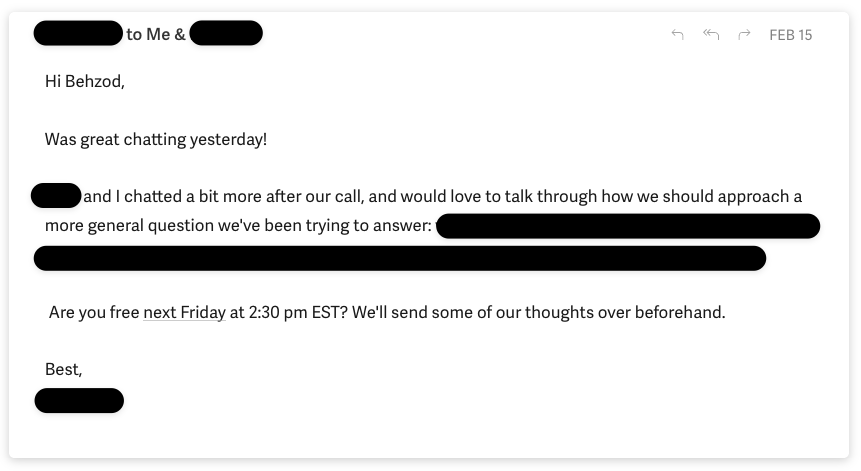
After our first conversation, it's clear that they have refined their thinking and want to go deeper in a specific area. The conversation shifts from a broad problem space "understand our users" to a more specific question [redacted].
As I mentioned, this is helpful signal for me because I can gauge whether or not our conversation helped them make progress (or if they went in a different direction) and if the new topic is more nuanced or not.
We have a second call, which follows a similar style. They talk. I listen. I ask questions. I listen more. I poke and prod. The conversation feels productive and enjoyable to me, and it seems like they agree. Towards the end they ask "What would it look like to continue talking with you? How do you normally work with companies?"
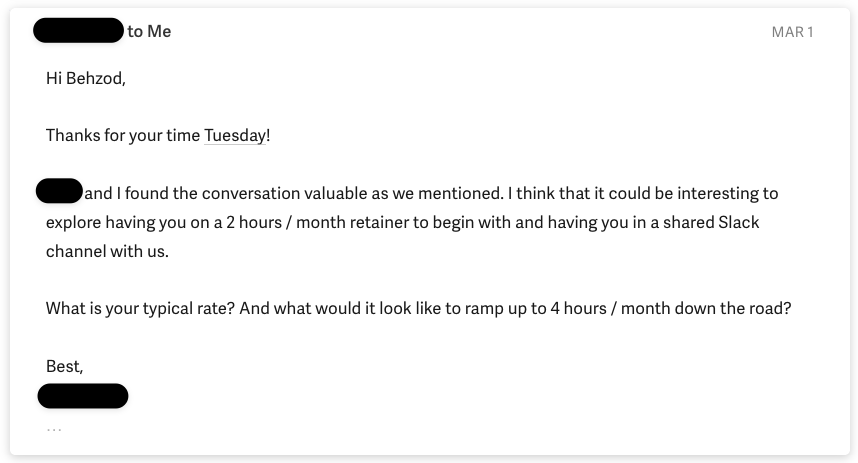
Now, if I had tried to sell them before I started doing the work, I would have shared the option(s) they had, including format and price. Those may or may not have made sense. But more importantly, the description of how I work with companies would pale in comparison to what it feels like when I work with them. Telling someone that me being in your Slack channel probably doesn’t sound valuable until we’ve had a number of conversations where you can evaluate if I’m a useful sparring partner, and it meaningfully undersells what it is that I’m actually providing.
Because we've already been talking for a while and I have a sense for both the kind of help they need and the pace with which they can digest and act on my feedback, I'm able to make a more informed proposal (and hopefully set us up for a more successful relationship) and they’re able to make a more informed decision. I never want to suggest a structure that feels unsustainable on either my end or the client’s, so getting reps in together helps me (and them) evaluate if we can work together at each others’ pace.
(Note – This went over well. We worked together for a number of months and still keep in touch.)
Don’t impose a shape, discover it
Not every conversation I have turns into a client relationship. If it did, my diagram would look incredibly linear without any branching. The reality is that being hired to care means being open to different shapes and configurations of work, and imposing a specific shape before you know what’s right is an easy mistake to make that comes from scarcity rather than abundance.
The best way to define a consulting engagement is to discover the shape through the work itself. Even in situations where my suggested shape is rejected, I’ve found that clients work with me to re-shape things together, whether that’s the engagement itself, the timeline, or the compensation structure.
As an example, I recently got this back from a potential client about our partnership:
“[I] know this is a really different model than what we initially were thinking. Is this still interesting and worthwhile.. If not, let's we evolve our approach so you're still getting out of it what feels right.”
We went on to redefine the work together, and came up with something that probably makes more sense overall. This conversation could only be had because we both approached the potential engagement as a partnership, not a one off transaction or sku that needed approval or rejection.
This is the third essay in my series on being solo / consulting, following Me-as-a-Service and Being Hired to Care. If you're considering this kind of journey for yourself and you think I can be useful, don't hesitate to reach out.
Thanks to Tom Critchlow, Kira Klaas, and Carol Rossi for feedback on past versions of this.