The Niceties That Matter
We have limited time here and there's really no reason not to make it a little better for everyone you interact with.
This is Yet Another MAEKAN Briefing Intro.
I’ve become a regular at a nearby restaurant thanks to my friends' recommendation and my subsequent visits, where I've tried to bring anyone who would let me. When I say "visits," it means at least once a week for the last 8 weeks, so not too bad.
Besides the food — which is excellent — the thing that keeps me coming back is the people who work there and the relationships that we've developed. I'm greeted by name and can greet most of the front of house staff by name as well.
We recently had a friend's birthday dinner there, originally making a reservation for 6. A few more people joined, so I called and asked if there was room to expand, bringing us to 9. Later, even more joined, so I went early and apologized profusely for being those customers. They took it in stride (probably because they are professionals), and turned the tables on me, asking more about who else was joining and how they could help us best celebrate.
Last week, I went for a solo meal and was feeling terrible after something I had eaten for lunch. Noticing I was in weaker spirits and the terrible look on my face, the waitress brought me a house-made digestif, unprompted.
Both of these experiences left quite an impression. This restaurant and these relationships have been a constant reminder that businesses are just people — which should be obvious to someone who is a single-person business, but alas. It's encouraged me to look for the humanity in all of my interactions, whether it's adding a smile to the end of the thank you, or letting the new tailor know how well-loved she is on Yelp.
These little things (being a good person?) seem to go a long way, especially as many of us crawl out of the anti-social COVID cave and have to learn how to engage with others again. But I recognized how easy it was to write off any organization as a faceless group and how I really don't want to live my life that way. We have limited time here and there's really no reason not to make it a little better for everyone you interact with.
What does digital patina look like?
If you pick up your favorite book, the pages it naturally opens to are probably the ones that have been read the most. The spine and creases acknowledging the importance over time. But what does that look like in a digital world? We don’t see the wear in files the way we do in books.
This is Yet Another Maekan Briefing Intro (Thursdays’ Briefings are for subscribers).
There's something magical about a well-worn object. The wear marks tell a story about its life; where it has been and what it has done. Patina — to me — is a visible indicator of love. The more worn, the more appreciated.
If you pick up your favorite book, the pages it naturally opens to are probably the ones that have been read the most. The spine and creases acknowledging the importance over time. But what does that look like in a digital world? We don’t see the wear in files the way we do in books.
Perhaps that's okay, because the file is as good now as it was when it was created. But are "favorites" or "date last modified" really helpful proxies for how much something is loved or referenced? What's the digital equivalent of a torn page?
In some ways, I wish my files wore down, reminding me of their age and their use — letting me know that they've been seen and appreciated. I know this is a silly thought, because it's the physical hard drive, not the file, that actually wears down and in many ways our files outlast our devices.
I wonder how this disconnect between the physical things we use and the digital objects that we rely on impacts our psyche when it comes to our perspectives on what we own, collect, and discard. Given that it's nearly impossible to modify an iPhone to survive multiple (software) generations, have we been conditioned to treat our digital access points as temporary goods but the digital goods themselves as eternal? Have we all become digital hoarders? Looking at the stack of hard drives next to my desk, I know my answer is yes.
Resilience and Growth
Resilience in some ways can be a double-edged sword, both helping you deal with difficult situations that arise, as well as shielding you from the friction around you.
This is Yet Another MAEKAN Briefing Intro.
This month, I've rejoined Nitzan Hermon's Critical Business School (I originally participated in January) and during our first session had a fantastic discussion about resilience - for many definitions of the word - which inspired today's intro.
In the conversation, one of the definitions of resilience that was used was "the capacity to navigate uncertainty" and I posited that resilience is very much contextual. While we describe people as "resilient," we often mean emotionally resilient, financially resilient, physically resilient, or some combination of these and more. As we talked, I realized that resilience in some ways can be a double-edged sword, both helping you deal with difficult situations that arise, as well as shielding you from the friction around you.
If you're incredibly resilient and the "impact" of something is very low, you may not even register that an event occurred, compared to being not as resilient and being dramatically shocked by something. We wade through many of these "low impact" moments during our weeks, often thanks to resilience, but by ignoring them, can't prepare for the effect of them compounding.
Case in point, I'm in decent physical shape, but I'm absolutely terrible at stretching and mobility work (there's no Family Form in Seattle... yet). Running a 5K here and there doesn't impact me much physically, but running a few of them in one week really took its toll recently. It was a good reminder to be more intentional about interrogating where my own resilience may be "protecting me" from opportunities to grow or be more self-aware. It's also a good reminder to stretch a bit more - both my body and my mind.
Wishing you a week of resilience as a shield from unnecessary difficulty, but not growth.
Fragmented Photos and Forced Viewing
This is Yet Another Maekan Briefing Intro (Thursdays’ Briefings are for subscribers).
I always appreciate the thought that artists and creators put into the presentation of their work. Whether it's a chef with good plating or a writer with a well type-set and laid out book, I love knowing that they thought about how I would engage with their creation.
One of the places that I was initially a curmudgeon about this, but have since come around, is with fragmented photos on Instagram. I'm talking about those half-cut photos where you have to half swipe over and hold your finger there so that you can see the whole image. (If you aren't familiar with these, here is an example from @photo.pace or check out the Series App on iOS.)
When I first started seeing these, I was pretty annoyed that my viewing experience required a half swipe and a hold, and that I had my fat fingers blocking part of the image. But then I was able to step back and check myself, realizing that the people who were doing this were controlling the experience of how their work was being viewed by forcing me to pause, swipe, and hold the image in the frame.
This forced viewing wasn't a disruption, it was an invitation and a subversion of the typical one image per frame norm that we see on Instagram. Recognizing this quashed my grumpy attitude, helping me to see that this was, in fact, part of the viewing experience. It also caused me to step back and ask where else I may have written off an experience as frustrating, when it was actually a new (to me) form of meaningful friction.
Now when I see these fragmented photos, I get excited because there are two layers (or more) for me to engage with - both the photos themselves and the presentation. I feel silly that it took me this long to come around, but c’est la vie.
Yet Another Year In Review - Year 01
A broad and deep look at where things started, where I'm at today, and where I'm hoping to go.
Deep Gratitude (An Introduction)
I've told many of you that starting Yet Another Studio is one of the best decisions in my life. While the first year (May 2020-2021) was chaotic and terrible on so many dimensions, it's with great privilege that I recognize what a bountiful first year the Studio had, thanks to many of you reading this.
This "year in review" will be a broad and deep look at where things started, where I'm at today, and where I'm hoping to go. I hope that in reflecting about these things, they may be helpful to those of you considering similar paths.
Year One
In Yet Another Newsletter - Issue 001 I asked and answered "What is Yet Another Studio?"
I hope the honest answer to that question, at least over a long time horizon, is something that mattered. I chose the name “Yet Another” because I want to acknowledge that the Studio is one of many options and because I want clients to think critically about what they are making in a world of excess and planned obsolescence.
The truth is the Studio is a vehicle for me to help drive the kinds of changes I’m excited about seeing in the world. Right now, much of that work is focused on research and how research is practiced, but I have hopes of expanding the scope as I go. I’d love to bring on talented people I respect as collaborators, and leverage our skills in areas where they can be impactful (more on that later).
What I didn't realize then, but have since articulated much better, is that I deeply believe that researchers (and the research process) is much valuable far earlier than companies usually hire for it, and I wanted to start to work towards testing and proving models of how researchers could play in that space. In taking a portfolio approach to my work, which I talk about below in "Me-As-A-Service," I've been able to chip away at different ideas, engagement models, and partnerships.
The first year went very differently than I had expected. I did fewer speaking engagements and workshops and far more embedded work with companies. I'm happy about this outcome, since I imagined the embedded work would be harder to come by. Thankfully, there's a lot of folks who believe in me (thank you!) and I'm grateful for the range of projects I've gotten to work on.
The Work Itself
I'm learning that I still have a pretty wonky elevator pitch, or at least an abstract answer to the question "What do you do?" (which - very fortunately - hasn't become a problem given my clients come almost exclusively from referrals, but it something I should be better about). At the highest level, all of my work is oriented towards helping organizations make better decisions and learn more effectively - and the work itself is a mix of playing and coaching.
In the past year, I've run research for organizations and on organizations, planned research (but not conducted it), given feedback on research (that other people did), helped teams build a decision roadmap off of their product roadmap, taught people how to conduct research, built hiring roadmaps and written job descriptions, suggested and evaluated tools for an organization, wrote performance feedback for clients (that gave me warm fuzzies) and a range of other things that typically get lumped into the name of "strategy." All this to say... whatever it was that would move the client forward.
One reason I'm so open to many activities is that I invest a lot in vetting my clients, because I prefer to work with people, not for them (this is a 100% semantic statement). I call my clients "partners" because in many cases I look like an extension of the team, albeit one with the freedom to play the fool. For many of them, billing on a monthly or per-project basis removes the need for people to ask if it's okay to reach out to me, worried it'll count as billable hours. The goal is more open lines of communication so that I can contribute however is necessary and have more visibility and transparency in the organization to be proactive about how I help.
Since Tom reminded me to keep track of things I'll want to remember in future years, here's a quick snapshot of the who and what in Year 1.
Partners:
Figma
UXRC/Learners
Asurion
Reforge
Dropbox
Balsa
Nearby
HmntyCntrd
Projects & Partnerships:
10 total
2 Open-Ended Partnerships
3 Speaking Engagements/Workshops
5 Fixed-Term Partnerships
Writing:
I wrote two extended essays and three issues of Yet Another Newsletter:
Year Two (and Beyond)
Beyond the kinds of work that I'm already doing, I plan to lean into the Yet Another moniker and expand it into a full alphabet. I started the Studio to give myself a vehicle through which I could experiment, and as I've started to connect with more folks outside of my main orbits, I'm increasingly excited about collaborating on other things. I'm hopeful that throughout the rest of my career, I'll continue to fill out this alphabet, so we'll have not just Yet Another Studio (S) and Yet Another Newsletter (N), but perhaps Yet Another Book (no idea the topic), Yet Another Camera Strap (why not?) etc. I enjoy freedom within a framework, and what better way to shape my career by giving myself a structure within which I can continue to play...forever. If you have an idea for making yet another [something] together, let me know.
Lessons Learned
This next section is pretty self-explanatory based on the title, but I wanted to take time to share conversations that I've regularly had about the journey so far.
Starting Warm
One of the first things I want to reflect on related to year one is the importance of "starting warm" (as opposed to "starting cold").
When people ask me how I was able to transition away from Slack and into the Studio, I'm honest about the fact that I had job offers (or offers in process) from other companies which I was excited about (in terms of the work), but knew I wasn't ready for (in terms of the work commitment). I shared these feelings with the respective hiring managers, explaining what I wanted to try with the Studio (as best as I understood it then) and asked if we could scope out a partnership that covered some of the potential work. I'm wildly grateful to Cristen Torrey (and the team) at Figma for taking a chance on me and being the best first partner I could ask for.
If you read other advice on how to start a new thing, there's often some version of "do something to de-risk it" which could be moonlighting, splitting your time, etc. In my case, I was already helping friends navigate the kinds of problems I do with the Studio, just for free and in my spare time. Towards the end of my time at Slack, I received increasing interest in help, and it was much easier to let go of one thing when I already had my hand on another.
Related to the idea of de-risking things, one policy that I have is "everyone gets one meeting." I am happy to talk to potential partners and even jam with them in ways that may look or feel like the work that we could do together to allow both parties to evaluate the fit of the partnership. I'm not in a rush to sign a contract and I want to make sure both of us know what we want out of the relationship.
The last thing I'll say here is that in addition to starting warm from a client perspective, I also "started warm" financially — I saved up and set aside ~ 9 months of living expenses. If I hadn't found work in 6 months, I'd start interviewing for jobs again, with a 3 month window find one. This massively reduced my cognitive and emotional burden to say yes, which I'll talk about towards the end.
Me-As-A-Service
The most important perspective shift I had to make in starting the Studio was recognizing that my business is effectively "Me-As-A-Service." I talk about the Studio in "we" terms in various places (for a number of reasons), but people are (at least right now) hiring me. This is as terrifying as it is empowering.
Let's start with the scary — it's all on me now. I'm responsible for finding work, doing (good) work, getting paid, and all the other aspects of running the business... not to mention taking care of my health and sanity. I went from a situation where I had teams of people taking care of each of those things to having all the responsibility. That part can be scary, not to mention that those of us who battle with imposter syndrome are about to have that cranked up to 11.
But, when I'm really honest, it's been much more empowering for me. I think that imposter syndrome is not my favorite framing for the experience of being in an environment where you have not yet leveraged your strengths, because the reality is that you're not an imposter anywhere you go — you're you, and you're the only one who can be you. When I take that perspective, I feel empowered to ask myself "what is it that I want to offer?" and do this from a place of strength and self-awareness. I am fortunate that I started working with a coach for months prior to starting the studio who helped me identify things that lay at the intersection of what I'm good at, what I find energy doing, and what other people ask me to do to build the core offering of the Studio.
The challenge for me was about converting those strengths and the things I wanted to offer into something that I could actually offer as a product/service - whether that's a talk, workshop, project, partnership or something else. Doing that required a lot more reflection and self awareness as I considered my own life rhythms, the ways I wanted to work with other people, the kinds of things I wanted to work on, and how I could talk about and sell that vision. Very thankfully, I'm friends with many of the kinds of people I'd love to work with and for, and many of them were incredible sounding boards as I worked through these ideas.
The final piece here that I'll share is the idea of "choosing your stress." So much of my work is oriented around the kinds of challenges that I want to take on. I know that not every partnership or project is going to go smoothly all the time, but as much as possible, I want to be facing challenges I'm excited about, not ones that are going to wear me down.
If you're considering an independent path, some of the questions I'd encourage you to reflect and write on are:
What is something that only you can do (or that you are uniquely qualified to do)? With that in mind, who should hire you, and why? What would that work look like?
What kind of work do you not want to do?
What do you want your days/weeks/months to look like?
What activities do you need to make space for that will allow you to continue to do the work you're excited about and proud of?
As a footnote, one thing the above questions helped me realize is that some of the ways I wanted to contribute to companies were better fits through angel investing or advising. This allowed me to say no to things that looked like a good fit, but weren't.
Playing vs Playbooks
I'm a framework and process person, which is great in some situations and absolutely miserable in others. Trying to operationalize something that's still being formed makes a lot less sense than simply putting up guardrails and helping it move more effectively in a direction. It was important for me to hold on to the idea that every client, project, and partnership would look different for a while as I learned my own rhythms and honed in on what I wanted to contribute and how.
While I had ideas about what the work would look like, the reality is much messier (and thankfully, much better). I tried my best to not lock myself into ways of thinking or ways of being early on, instead reflecting regularly about what was and wasn't working, what felt good (or didn't), and what I was drawn towards. I shared thoughts with friends, solicited feedback from partners, and wrote regularly to have a one-directional time machine to refer to.
One of Balsa’s core values is the idea of "planning versus plans," and in learning from them, I've co-opted their idea into playing versus playbooks. I've had to recognize that every situation is unique, and bringing an open mind and ways of being into a situation, rather than things to do, yields the best results. This isn't to say that I don't have consistent patterns in the work, but that force-fitting them into a situation is a fool's errand.
If nothing else, a principle to remind you to keep looking at things in a new way and asking what else may be possible is a good thing to keep you from being complacent.
Saying No
One of the most difficult things (for me, and probably many of you) is learning to say no. I tend to be reasonably good at holding an abundance mindset and fighting off scarcity, but that took a lot of work (thank you, Sunil) and continues to be a muscle I have to exercise.
As I mentioned in "starting warm," setting up a financial buffer to work from gave me immense privilege in looking for the right kind of work. I know that saying yes to the wrong projects can become a downward spiral of resenting the work, then doing poor quality work, then not getting the kinds of things you want in the future, and so on. On the flip side, saying no to projects that aren't the right fit opens you up for the work that will be.
Many projects sound good at the beginning, especially as they are being pitched to you. Part of my rule of "everyone gets one meeting" is allowing me to get past the optimism of the pitch and understand what I'm signing up for with more clarity. There are lots of projects that have come my way where the first meeting allowed us to realize one of a number of things:
I'm not a good fit for the project.
The project is actually a different scope than the client thinks.
The project, as it's written, is not worth doing (though maybe another one is).
One meeting was all they needed.
In most of these cases, I'm happy to help (within a reasonable degree) in steering them toward a better partner (if I know one). This means everyone goes home happy — I'm not doing work I shouldn't be, and the client gets what they need.
Derek Sivers' framing of "Hell Yeah or No" is a succinct guide to how I feel about projects. If I'm not stoked, I probably pass. Related, one fantastic exercise I did early on was make a list of "dream clients." I refer to this often and occasionally reach out to some of them where I think there may be a fit. Doing this pushed me to dream bigger and think about what's possible, not just in front of me.
Other Things of Note
One of the great questions I've been asked as I talk about the first year of the studio is "What would you have done differently?" (thanks Justin).
While "not start in the middle of a global pandemic" is a bit tongue in cheek, I also think it's almost completely wrong. I was planning for things to be difficult (in a very different way) and I think that learning how to operate in a difficult environment has been incredibly valuable (time will probably be the best just there).
Something I do think I would have done differently (and have started doing) is planning vacations well ahead of time and irrespective of my current/potential clients. If I'm going to run the Studio in a sustainable way, I need to make sure that I'm taking care of myself and know how to put on my oxygen mask before helping others.
Another thing I'd like to have done better is get other people involved. I'm very excited about how I'm opening up the practice, and I'm really looking forward to carving out more projects that allow me to bring on and learn from other talented friends. I'm in the process of redesigning the Studio website and look forward to more prominently sharing Friends of the Studio that I'd encourage everyone to partner with.
Thanks
If you've read this far, thank you. If you were hoping for more tips about how to start as an independent, I have a short video series coming out with Learners soon called "Going Solo" (which I'll link to and update the tense of this sentence with when it's ready). I really see the Studio as a vehicle by which I get to be myself, professionally, and I want that for more people. If I can help you do that in any way, please let me know.
Finally, there are a tremendous amount of people in my orbit with whom I could not made it this far. While I could write essays about each of them, I do want to acknowledge them here, so a massive thank you to Jim Lee, Kevin Hanaford, Kunal Tandon, Parteek Saran, Max Di Capua, Sunil Arora, Tom Critchlow, Eugene Kan, Vivianne Castillo, Alec Levin, Lena Blackstock, Colette Kolenda, Jan Chipchase, and everyone who hired me. I'm so grateful that I've made it to year two with your help.
The Seattle Music Scene
Community is about empowerment. Good communities not only make space for who you are today, but they help you see and realize the person that you want to be tomorrow.
The Moral
Community is about empowerment.
Good communities not only make space for who you are today, but they help you see and realize the person that you want to be tomorrow. In all of the talk about "communities" on Twitter, so much is missing about the fact that communities are not simply about people being in the same space... even for the same goal.
Community is about the energy that we put into each other and into the united "us," owning a part of that story and adding our voice to the collective narrative, rather than trying to assimilate everyone to the same perspective or way of being.
The Story
Intro
The following is not anything close to a history of the rich and extensive Seattle local music scene (Kelly Mason is probably a much better historian and, on an unrelated note, her "Myspace Profile Songs" playlist is a gem). This is merely my own reflection of the incredible and transformative experience I had being a fan, friend, and musician from 2003-2013 in one of the most accepting and lowest ego communities I've ever encountered.
This entire reflection was spurred by a dinner I had recently with a college friend and her new husband, whom I discovered was the front man for a band I grew up watching with reverence, as they had the respect of the artists I knew and loved.
I deeply believe that the Seattle local music scene, especially around these years, was a special place. If nothing else, I hope this post pays tribute for so much of the good that came from it for me (and many others).
Verse 1
To set the scene, it's important for me to acknowledge that a tremendous amount of my emotional education came through music. I started playing piano (poorly) in the fourth grade, eventually switching to clarinet and saxophone, and finally falling in love with drums. While I'm sure many of you will laugh, I look at Linkin Park as a gateway to many of the different genres and bands whose music and lyrics would become part of the rhythm of my life. Their blend of emotions and range of musical styles made it possible for me to go in so many different directions as I matured.
I also need to acknowledge Jim Lee and Josie Ng as two of my musical spirit guides, especially as it relates to Seattle music and the entire emo/indie genre. Jim lived with me and my family in 8th grade, and opened my eyes to Thursday, Yellowcard, and Saves the Day - three groups from different parts of the music spectrum who would all become mainstays in my CD player (and eventually iDevices). This foundation made it possible for Josie to indoctrinate me into the local scene two years later, seeing Gatsbys American Dream at El Corazon (then Graceland) and going to my first small venue to hear Danger:Radio, Blaine, and This Providence at the Kirkland Teen Center.
Verse 2
When I try to explain what was so special about the scene, I always talk about the people. It was a collection of low ego misfits - for the most part - who were there for the music and each other. The venues and audiences were spread across the Seattle area, ranging from Edmonds and Mukilteo in the North, to Kirkland, Bellevue, and Redmond on the Eastside, to Seattle proper, and even down South in Tacoma. It wasn't uncommon to see the same people week after week at different venues, even though some nights you drove 15 minutes and others over an hour. Everyone came to support their friends and the artists (often the same people) and be in community together. Conversations in line would be as lively as the parking lots after the show.
The artists themselves played every show as if the 15' x 10' stage at Ground Zero was the main stage at Warped Tour. They poured their hearts into their guitars and their souls into the microphones. Instead of hanging out in green rooms, waiting for their turn, almost all the artists were out watching, cheering, and singing along to other acts. They had guitars ready if something went wrong and probably helped each other with load in and load out. You left every show simultaneously energized and exhausted.
Breakdown
When I finally started a band with my friends Andy, Riley, and Kevin (who would go on to have a much more successful music career, in addition to his real one), we were limited only by our imagination and will. We'd been to enough shows, and helped others load in and load out enough times, to develop relationships with our then-heroes and booked Oceans in Oblivion, Lizzie Huffman, and Blaine at our first show (which we opened). In some regards, we had no business playing with the caliber of musicians we did, but, true to the scene, no one cared. People loved that we cared about the music and put in the work, so they supported us. That's what made Seattle special — everyone wanted you to be the best you could.
Verse 3
After going to college and coming back to Seattle, I was fortunate to make my way into a different local music scene - hip hop. Instead of Danger:Radio and Blaine, I found myself regularly supporting and hanging out with Brothers from Another, The Physics, Blue Scholars, and many other talented emcees. In that world, I found a similar dynamic — less ego and more support. The older generation of artists were regularly carving out space for who came after, guest appearing on tracks, inviting them onto show bills, and showing up at concerts to support them. It made me think that it wasn't just the indie scene of the 2000's but something about Seattle music that brought people together in true community (#townallday).
Whether it was listening parties, music videos, or just a bbq, people showed up for each other and to celebrate each other. Every individual win felt like a win for the city, and we were all there for it. For me, it was incredible to feel that same raw energy I did in high school, half a decade later in different venues to different beats.
Outro
To borrow from "Yes, This Is About You"... where's the fucking chorus? I don't know. It's hard to know what the anthem or repeated lines were across this special place in the corner of the Northwest. I know that there's magic here, because as I sat at dinner last night reminiscing with someone who was a generation before me musically, it was clear that we both had lived it.
Song Notes
While I recognized some of the people who started me on this journey, I also want to recognize so many folks who contributed to those years. I feel so thankful for Danger:Radio (Andrew, Marvin, Nico, Spencer, Matt, Elan), Blaine (Chris, Paxton, Chip, Rory), From Aphony (Jake, Jacob, Mike, Keef), Lizzie Huffman, Oceans in Oblivion, and everyone else we got to share the stage with. I am grateful to the guys in Surrounded by Lions, Gatsbys American Dream, Portugal: the Man, and Forgive Durden for putting on such incredible live shows and proving that you could write atypical songs in a way that was true to you and be not just accepted, but loved. I want to thank The Physics and Blue Scholars for investing deeply in the community and opening doors (literally and metaphorically) for others. I'll never forget your open studios. A huge thank you to Hollis for being a true friend and contributing to my musical and emotional education, long after we've both left Seattle. Finally, thank you to James for giving me the ability to dive back into this rich history and tap into a part of myself that I haven't sat with for a long time.
Intellectual Honesty in Fashion
You know what’s better than carrying your jacket? Slinging it across your back. You know what's better than wearing a belt (most of the time)? A drawstring.
This is Yet Another Maekan Briefing Intro (Thursdays’ Briefings are for subscribers).
With record-setting temperatures here in Seattle, I’ve found myself spending quite a bit of time at the lake. My newest companion is one of Outlier's latest experiments, the grid linen beach hole (yes, that’s its name) — a blanket that converts into a bag of sorts.
I'm not a minimalist, but I do appreciate and seek out objects that not only do their core jobs well, but also invite me to expand my understanding of how to use them. I think beyond the idea of being “well-designed;” I instead consider these things to be “intellectually honest.” Two of my favorite examples are Acronym’s JacketSling and the drawstring in Outlier’s New Way Shorts.
Both the Acronym jacket and Outlier shorts do their jobs incredibly well, unhindered by the (arguably necessary) additions, while simultaneously helping the wearer realize that every prior version of a similar object lacked the recognition that an alternative future was possible. A better future.
You know what’s better than carrying your jacket? Slinging it across your back. You know what's better than wearing a belt (most of the time)? A drawstring.
In some ways, this honesty is empowering — what an incredible thing to have objects (and their makers) that see more in themselves than you do and invite you to realize their full potential. But in another way, it’s a damning indictment of the many other things out there which are strictly worse on so many dimensions.
Just like the double zipper before them, the JacketSling and drawstrings have set a new standard for what I want in my clothing.
Microdosing Friendship
If you have any friends or follow anyone in NYC, especially single people, you know that “nature is healing.” People are out and about, mask mandates in the states are being relaxed (rightly or wrongly), and we’re starting to move towards a post-pandemic reality — whatever that means.
There's a lot about the pre-pandemic world that was broken, and while the last 18+ months have done incredible damage — especially to already marginalized communities and peoples, I'm optimistic that we'll rethink so much of what we do and how we do it as we move forward. One of those things, for me, is the way I engage with people.
As an introvert, I draw so much energy from my time alone. Caveating a ton of privilege, the necessity of being indoors throughout this crisis has helped me develop a newer, more sustainable relationship with myself, especially as I renegotiate my time and relationship with others.
In that vein, I came across an amazing post from my former colleague Kat Vellos on "microdosing friendship" — a call for us to intentionally weave these moments of engagement back into our lives as the world opens again. I'm a big fan of her work, including her suggestions for better questions than "How are you?" and her recent book on developing adult friendships “We Should Get Together.”
Besides friendship, what relationships have you reconsidered, redesigned, and redefined over the past 18 months?
Energy Surfing
“You have to ride the waves you’re given.”
Yet Another Maekan Briefing Intro.
Over the last few weeks, I've had wide fluctuations in my energy. Some days I've struggled to focus, other days the world has melted away and I've forgotten to eat for hours as I tunnel into the work.
Initially, this was frustrating and hard to deal with as I tried to balance work, friends, family, and my own needs. I was hoping that energy would align to the events on my calendar and that I could summon my attention when I needed to. It just so happened that I caught up with a friend during the same period who had also struggled with this earlier in his life, similarly in a switch away from a corporate role into an independent career.
This friend happens to be surfer, which led him to share the advice I needed to hear: "You have to ride the waves you're given." He reminded me that while there are definitely things we can do to better manage our energy, lots of things are outside of our control. Some days - especially over the past few months - we get news that throws us off course. Or some things just don't click. Other days we're in flow when we want to rest. Rather than fight it - or trying to surf a wave that isn't there - he encouraged me to harness it. To breathe in the present moment and do the work that was in front of me.
While hearing that - and saying it to myself over and over - was helpful, it hasn't been easy to put into practice. I'll regrettably want to make progress on a project, only to find myself with too much physical energy at my computer and choosing to run instead.
As I learn how to be a better energy surfer, I'll pass on the advice to you, in hopes that it may help with the current tides in your life.
Work in a World after COVID-19
Exploring dichotomies in communication and labor that help me think about what work looks like in the future.
This was originally published 3/20/2020 on Reading Supply. Reposted here as I continue to aggregate some of my thinking about what will change with work after the world recovers from COVID-19.
Last updated on 2020.03.20
Primary Areas of Exploration
While I think that many types of work will be affected by the changes we see in the world, I'm not interested in exploring how things like grocery stores, primary care doctors, or civic infrastructure and services (police, fireman, etc) are going to change except where there is an overlap or a result of other changes. Perhaps this post should be titled "Knowledge Work in a World after COVID-19."
I am primarily interested in exploring how knowledge work will change. In that exploration, I want to define two (false) dichotomies that help categorize attributes of work:
D1: Communication AS Work vs Communication ABOUT Work
One of the most important distinctions in knowledge work is how communication flows and what communication flows around.
Communication ABOUT Work (CBW)
Communication about work is communication that happens external to the object of work itself and where the communication does not directly become a part of the final work.
An example of this would be Alice and Bob in Finance, working on an end of year report. Once Alice finishes everything that is her responsibility, she sends the Excel file to Bob and tells him “please update rows 1-2 with your information." This exchange is CBW because the communication that took place is not information that ends up in the spreadsheet itself - it has no representation as a cell of information. It is external to the document as an instruction for Bob to do his job.
Communication AS Work (CAW)
Communication as work in contrast, is where the communication that takes place directly informs, and may be a part of, the work itself. CAW is often seen when people are working on strategic projects, where people bring together different data points or evidence from multiple sources, and their communication that synthesizes this evidence itself is the work.
An example of this would be Catherine and Dave are working on a marketing plan for the following year. Through a series of emails (or messages in a Slack channel), Catherine and Dave both present evidence from recent market research and trend reports. Given their specific perspectives and experiences, the conversation that results — weighting this reports findings against another, bringing in business goals in conjuction with these findings — is communication AS work. The things that they decide in and through this conversation can be directly reflected in the marketing plan itself.
D2: Objective vs Subjective Labor
The second dichotomy to call out is objective labor versus subjective labor. This dichotomy highlights the degree to which there is a specific outcome that is correct from a type of action.
Objective Labor (OL)
I'm defining the term “objective labor” (OL) to refer to types of work where there is a correct outcome of the work that any individual who has awareness of a project would agree is correct. Regardless of who is doing the work, you would expect the SAME outcome.
Bringing back the Alice and Bob example, parts of, if not all of, Alice's and Bob's labor would be considered OL, because the outcome of the work is a completed financial report, which has known and agreed upon parts (profit, loss, unit costs, etc).
Subjective Labor (SL)
In contrast to OL, “subjective labor” (SL) is work where the process or path may be consistent, but the outcome of the work will differ based on who is doing it. In many ways, not just creative professions, but most professions where things are “made” (engineers, cooks, designers, etc) would fall into this category.
An example of SL can be seen in the example of Catherine and Dave, where the marketing plan will vary by the people involved. Even though the same base material is used, the creative decisions, channel selection, and dollar spend may vary because Catherine and Dave are involved, rather than Evelyn and Frank.
D1 X D2
The table below calls out what work looks like at the intersection of these dichotomies and helps us identify 4 types of work - Tactical, Strategic, Operational, and Veiled.
CAW x OL ("Tactical")
Def: Things in this bucket should result in the same outcome, regardless of who is involved, and the communication should be seen in the work.
Ex: Behzod's Note - Need Example here.
CAW x SL ("Strategic)
Def: Things in this bucket should result in different outcomes based on who is involved, and the communication should be seen in the work.
Ex: Design, Engineering, Marketing, PR
CBW x OL ("Operational")
Def: Things in this bucket should result in the same outcome, regardless of who is involved, and the communication will not be visible in the work itself.
Ex: Accounting, Enforcement of Law, Data Analysis
CBW x SL ("Veiled")
Def: Things in this bucket should result in different outcomes based on who is involved, and the communication will not be visible in the work itself.
Ex: Investing
(WIP) Effects on Each Type of Work & Worker
Small Acts of Support
An intro to the 4/1 MAEKAN Briefing about a nice way of uplifting one another with an unorthodox way of sharing music.
Written for the 4/1 MAEKAN Briefing.
As we come into the second year of this new, unsettling reality, I've been reflecting on some of the emerging practices that have been most enjoyable. One that stands out above nearly all else (besides not having a commute) is sharing music with friends.
I grew up playing in bands in a time when PureVolume links were a form of social currency. Sharing something you discovered with a friend was like opening up a part of yourself that you didn't know how to express.
Early last year — before Zoom fatigue hit — I did some "coworking" with friends which was effectively us working silently with video on, while someone had music running in the background.
We'd chat occasionally, but the goal was to simulate the environments we used to be in - offices, coffee shops, each other's apartments, etc. As the pandemic crept on and I wanted to show my face less, a different habit emerged - sharing music recommendations.
This is not the typical "check out this album that just came out," but something that felt more akin to making a mixtape for each other - friends would recommend me a song or artist based on an activity that was coming up. "I have to head out to cook" was followed by "here's something I've enjoyed playing in the background at dinner." "I need to really focus on this project" was met with "this playlist has been the best thing for me late at night to hit a deadline."
Sharing music became a way to support each other when the options felt limited. It's a small gift in a time where gifts feel anything but small. It's something I've come to treasure and try to practice more on my own.
If you want a rec, or have one to share, visit us in #music on the MAEKAN Discord.
The Disorientation of Being Home
Reflections on returning to Seattle after being away for nearly 10 years.
Another piece I’ve written for the MAEKAN Briefing.
I recently moved back to Seattle, where I grew up and spent the majority of my adolescent and adult life. Being back here and out of San Francisco — has been a strange experience on a number of levels.
On one hand, it's the first real "travel" I've done in a year, except for the prior visit up here to find an apartment. I enjoy traveling because it disorients me just enough to make me reflect on my life. The flight home from any trip inevitably finds me asking questions about what I missed when I was gone (and what I didn't) and what I want to bring home with me.
When leaving San Francisco and returning "home" to Seattle, I thought a lot about what I was leaving behind (and had made peace with) and what I wanted to bring with me. I also thought about what I was "coming home" to, given that I hadn't lived in the Seattle area in almost a decade.
The other strange thing about being back is how much of myself I see reflected back at me from the city. While I "did less" of my favorite things when I moved away from Seattle — some by choice (photography), some by circumstance (I didn't have a drum set anymore) — being back has invited those parts of me back out again. I live within walking distance of the venue where my high school band opened for our then heroes. I can bike around the campus where I went to graduate school and stop by the first classroom I taught in.
Being back - and having these parts of me invited out — makes me wonder to what extent I let my environment shape who I was when I was in San Francisco. I think it's easy to blame things that are external to us - our friends, our jobs, our environments — rather than accept our own role in change. But what I'm realizing now that I'm back in Seattle, is that while the city has changed, I am the thing that is both foreign and familiar. Seattle is simply a catalyst for that realization.
Accepting that I muted parts of who I am is the strangest feeling of all, because I don’t necessarily want to accept that I could have been fully me the whole time. Being home, I feel as though I'm reacquainting myself with myself. Maybe this is all a function of growing up, and now I can think even more intentionally about what I want to leave behind and what I want to bring with me in the months and years to come. Maybe being "home" is just enough disorientation for now.
Meaningful Friction
A short piece on my reading habits and meaningful friction.
I wrote this piece as an intro to today’s MAEKAN Briefing - a patron-only email that goes out on Thursdays.
—
For the last decade plus, probably thanks to the thousands of pages of academic papers I consumed earlier in my life, I've preferred reading digitally. My favorite way to read these days is with my iPad on the couch, where I use an Apple Pencil to highlight passages, and I take notes on my iPhone.
Yes, I literally switch devices to take notes.
I'm sure many of you who are productivity-oriented are shaking your head at me right now. Even though I have the exact same apps on my iPad, I lovingly put down the device and pencil and pick up my iPhone to tap (or swipe, more likely) together my thoughts. I do this because I want meaningful friction in the process of taking notes. I'm reading a book to read the book, not to have read the book, so I'm in no rush to finish it. Taking notes is, for me, an act of conversation.
By switching devices, I'm creating a moment of intentionality in which I ask "What is worth making note of here?" Doing this has made reading more enjoyable and helped me remember things better. It's also encouraged me to ask where else meaningful friction may create more intentional habits in my life.
Because no one relies on me to respond immediately as a part of my job (and because I check my phone often enough throughout the day), the search for meaningful friction has nudged me to enable "do not disturb" across all of my devices. In the same way that I ask myself "What is worth making note of?" I find myself asking "What am I drawing my attention to?" when I pick up my phone, since it no longer summons me on its own.
I recognize that this is an incredible privilege, and perhaps it won't stay this way forever, but it has been a wonderful experiment over the past few weeks - a recalibration of sorts where I've learned to listen to myself a bit better.
While I'm in no way encouraging any of you to join me on this adventure, I would leave you with the question: "Where might meaningful friction be welcome in your life?"
I’d love to hear from you on Discord — even if you don’t hear back from me right away!
Well-Worn Phrases
Inspired by Lauren Serota’s “words we don’t have,” this is a list of terms and phrases I find myself using on a regular basis. I imagine this will ebb and flow - as language does - but I wanted to make a record of these here.
Inspired by Lauren Serota’s words we don’t have, this is a list of terms and phrases I find myself using on a regular basis. I imagine this will ebb and flow - as language does - but I wanted to make a record of these here.
2022
“Relationshape” - drawing attention to the fact that the relationship is dynamic and has evolved over time.
“Return on Hassle” - a better framing (IMO) for the expected value of an outcome, taking into consideration the cost and friction of achieving it. For me, ROH has been one of the most helpful heuristics to think about what opportunities I pursue. It’s not about avoiding friction, rather ensuring that the friction is meaningful.
“State versus Trait” - the idea that some things are temporary/situational rather (state) than characteristics of a person/thing (trait).
2020
“Surface Area” - a reference to the amount of exposure that people share. I often mention that “Person A has a lot of surface area with Person B” indicating that they may have more data points, experience with, etc to that person.
“Directionally Correct” - This is perhaps my own attempt at something akin to a “yes, and…” where I agree with the spirit of what’s being said, but want to tweak it slightly.
“In Orbit” - I wrote about “Being in Good Orbits” for Yet Another Newsletter Issue 002 as a way to describe the relationship between people:
The idea of people orbiting each other appeals to me because it acknowledges that each of us have our own gravitational pulls - things that draw others into us - and that there’s room for many people to exist within these orbits at different distances. It also acknowledges the creative collision or serendipity that exists when people’s paths intersect.
What does collaboration feel like?
Sharing reflections from January 15th’s Critical Business Salon with Nitzan Hermon.
In this morning's Critical Business Salon, Nitzan Hermon posed the above question to the group. The two things that came to mind for me in our brief reflection period were:
1+1=11
"Tapping a tuning fork and hearing a harmony" (the idea of resonant frequencies)
1+1=11
This was perhaps my cheeky take on 1+1=3, but I wanted to capture the idea that you can still see the original contributors in the collaboration (both 1's are in 11), but through their collaboration, they've become something much greater.
"Tapping a tuning fork and hearing a harmony"
This was a a play off of Kevin Kwok's description of Twitter. What I liked about it is that collaboration in my mind is about amplifying each other - providing a lens, perspective, skill set, etc that enhances those who we are working with. The best collaborations I've had changed how I see myself and created outcomes that I couldn't imagine on my own.
The concept of harmony is very alive for me right now, as I've thought a lot about the ways that data needs to be harmonized not just triangulated. By that I mean that you want to use different sources of data that don't just reinforce the same story, but work together to create a new perspective that neither has on their own.
What does collaboration feel like for you?
Hard and Fast No’s
I have a hard time saying no. Period.
When I started Yet Another Studio, one of the first things my coach and I worked on was defining criteria that made it easy for me to say “no” to a project or a client. Some of this had to do with the industry or business model that they had (I don’t work with organizations whose economic prosperity depends on exploiting, endangering, or harming individuals) or the working relationship with the client.
This was helpful for me because it was an important muscle for me to build, and it allowed me to spend less time on things that were not going to benefit me or the business. Having a clear set of criteria of what I didn’t want to do, how I didn’t want to do things, or who I didn’t want to work with, made it really easy for me to identify hard no’s and do it fast.
It also helped me make decisions about how I talk about the business. A clear example of this is that I only work on a project or retainer basis. I don’t have hours that are for sale at a standard rate. Knowing this means that I decided not to put any cost information on the studio site because my time is not for sale outside of the scope of a project or retainer. This felt like a small thing at the time, but when I saw it in the broader context of what I didn’t want, it made perfect sense.
Four months into running the studio, my fast and hard no’s have been one of the most beneficial operating criteria. They’ve probably saved me dozens of hours at this point — both of my own emotional energy and time and calls that I would have had with clients who were not a great fit.
If you find yourself starting down the path of consulting, or even find yourself on that path and feel like you’ve been spending too many hours following bad leads, I’d encourage you to make time to be clear with yourself about the criteria that get you to that hard no, quickly. I promise it will pay off down the road.
After School Bike Rides
I used to ride my bike a lot - much more than I do now.
If you follow me on Instagram, you’re probably wondering how that’s possible. In junior high and high school, if I wasn’t working after school, I was probably on my bike. Being on a bike was never about the destination, and most of the time I never knew where I was going. I simply enjoyed the ride. I picked a direction and I would wander. This was easy because I had a bike that embraced both dirt and concrete features as just that - part of the journey.
After living in the Bay Area for the past 6+ years, I’d lost that sense of wander when it came to biking. I’ve spent so much time on the same roads, I can visualize every twist and turn and found it harder and harder to get out of bed in darkness and dress for a ride.
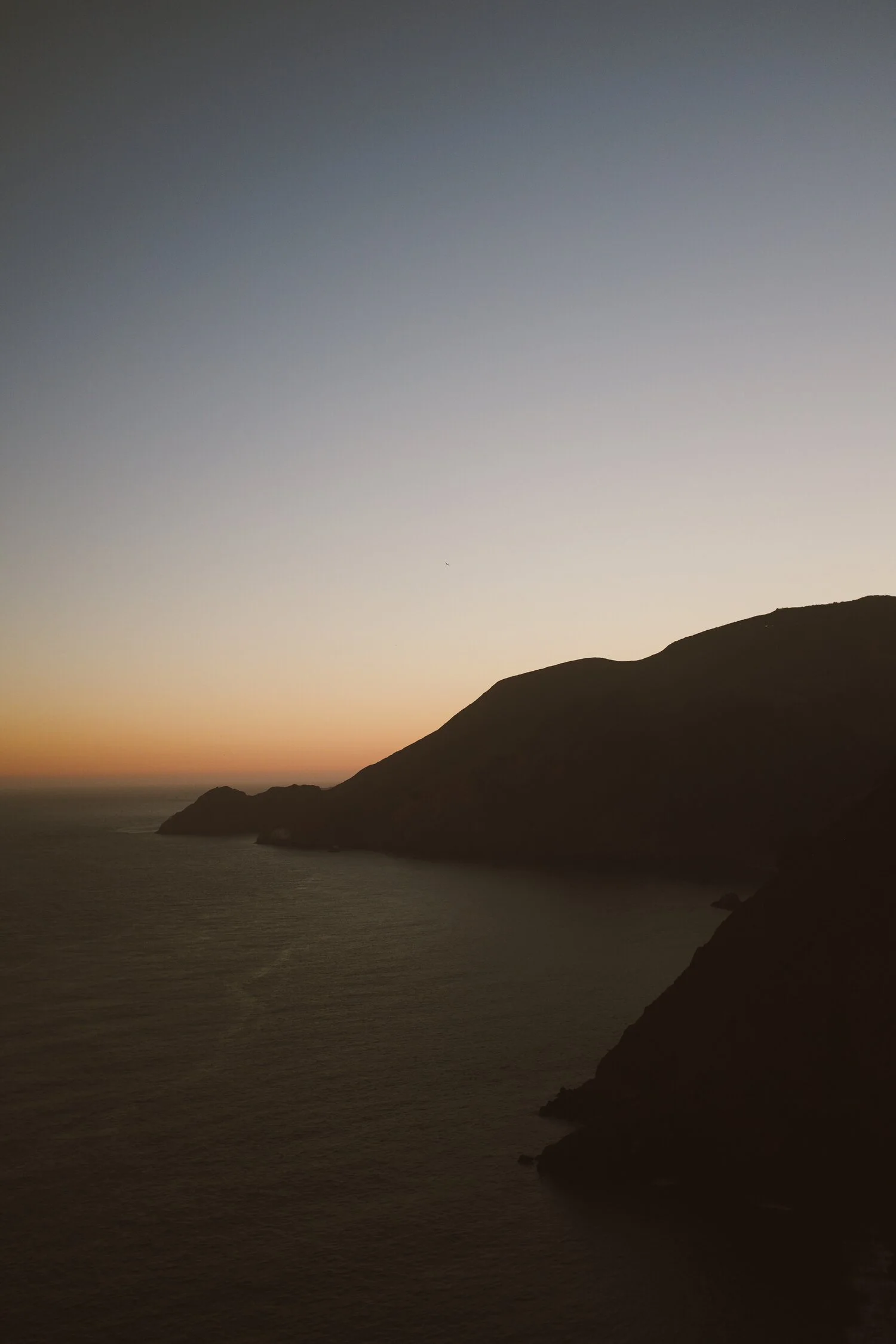
Recently, I picked up a new bike that more eagerly embraces a journey off road. Part of me wanted to explore a new style of riding and a part of me wanted to go back to my roots of simply getting lost. Inspired by some beautiful adventures that Tyler and Naz have been on lately, I decided to get lost and catch a sunset in the Headlands last week. I had snacks, layers, and lights, but no agenda or clear sense of where I was going.
It was the first time in years I felt that same feeling from high school. I wasn’t on the bike for any purpose or direction, I was simply out there to enjoy the ride.